
Pension Offsetting vs Pension Sharing for Doctors approaching retirement

For many doctors approaching retirement, a pension is likely one of their most valuable financial assets as well as the foundation for their long-term financial security throughout the later years of their life. When divorce occurs later in life, decisions about how that pension is dealt with can have lasting consequences for both parties’ retirement income and their overall financial wellbeing. In England and Wales, two of the most common approaches are pension sharing orders and pension offsetting, each offering distinct advantages and potential drawbacks depending on the circumstances. For doctors, these types of decisions are rarely straightforward. NHS pension schemes are complex and often there might be the need to consider one’s private pension. This means that achieving a fair financial settlement when pensions come into play requires careful legal analysis and expert advice. This article explores the differences between pension sharing and pension offsetting, the factors that influence which approach might be more appropriate, and highlights why specialist advice is essential when navigating these complex financial issues.
Pension division on Divorce in England & Wales
In England and Wales, pensions built up during the marriage are treated as matrimonial assets and can be considered for division when it comes to determining the financial outcome of the case. In many cases involving doctors approaching retirement, pensions represent a substantial proportion of matrimonial wealth, making them central to negotiations. While the court will consider the value of all assets collectively, there is an increasing recognition that simply offsetting a valuable pension against other assets may not always produce a fair outcome, particularly where one party’s retirement security would be compromised. As a result, pension sharing has become more and more common.
Why Doctors’ pensions are different

Unlike many other professions, doctors often accumulate pension benefits through the NHS pension scheme. This is one of the largest and most complex defined benefit pension schemes in the UK. NHS pensions provide a guaranteed income in retirement calculated according to salary, length of service and the particular section of the scheme to which a doctor belongs. Many doctors might also have additional pension arrangements through private or personal schemes, creating multiple assets that must be considered upon divorce.
Through financial remedy proceedings relating to divorce, the Cash Equivalent Value (CEV) is used. However, this does not always reflect the true value of the future retirement benefits, particularly for defined benefit schemes. This is why obtaining expert advice in the form of a pension report (from a Pension on Divorce Expert “PODE”) is particularly important when considering the financial outcome of the case.
What is pension sharing?
A pension sharing order is a court order which allows one spouse or civil partner to receive a percentage of the other person’s pension as part of the financial settlement. Usually, the aim is to equalise pension capital or income upon retirement. Once the financial consent order has been approved by the court, implementation of the pension sharing order can begin. The agreed percentage is transferred into a separate pension arrangement in the recipient’s name. This ensures that both parties are fully able to support themselves in retirement and enables them to have a clean break where possible.
Particularly due to the fact that NHS pensions are often defined benefit schemes, it is important to obtain a pension sharing report from a qualified expert (PODE). Whilst pension sharing orders can involve additional costs and administrative processes, it is often the fairest way to divide these valuable assets, particularly where retirement is imminent and there is limited opportunity to rebuild pension savings. That is why it is very important to obtain a pension sharing report to ensure the agreed percentage of the sharing order is correct.
What is pension offsetting?
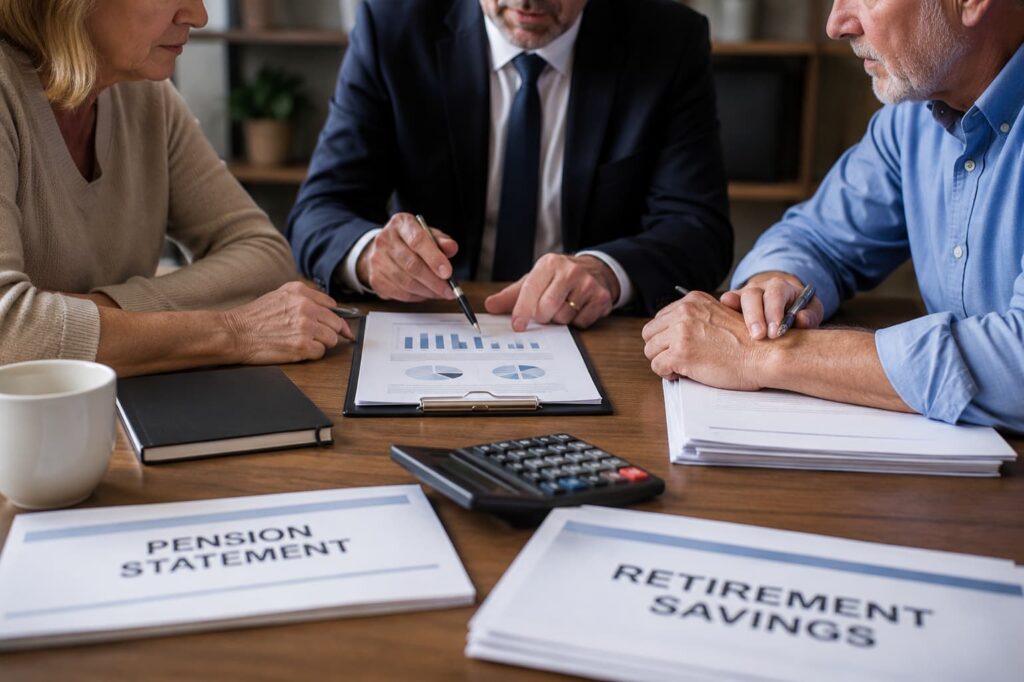
Pension offsetting is a method of dividing financial assets on divorce in which one spouse retains a larger share, or all, of a pension while the other receives a greater share of non-pension assets, such as the family home, investments or savings.
For doctors, this approach can be attractive and something to consider as it allows valuable NHS or private pension benefits to remain intact. It also avoids the administrative complexity of implementing pension sharing orders and could help to keep costs to a minimum. Overall, pension offsetting keeps things simple. It might be the case that both parties have their own pensions and it allows them to remain where they are. Each person does not need to worry about changing pension providers.
However, pension offsetting does have its limitations. Accurately valuing pension benefits can be complex, creating a risk that the pension is over-valued or under-valued within settlement. Pension benefits cannot be treated the same as cash in the bank and the value of a pension cannot be given a pound for pound value. In addition, receiving more capital today does not necessarily provide the same long-term financial security as a guaranteed pension income in retirement, making it difficult to compare immediately available assets with the future value and certainty of pension benefits.
If you do decide the ‘offsetting’ approach, you should still obtain some expert advice from both a specialist family lawyer and a PODE so they can determine the amount of pension assets that need to be offset against other capital assets to achieve a fair outcome.
Pension offsetting process
The starting point is to work out the total value of the matrimonial pot. This will provide you with the total that needs to be divided between the parties. Then, you need to obtain the capital values of the pension assets. This can be done by obtaining the CETV from the pension provider.
However, the CETV might not always represent the true value of pension funds taking into account all of the benefits. As such, it is recommended to seek advice from a pension expert. The expert can then consider how much of a non-pension asset is sufficient to offset the value of the pension. The expert can also provide advice on any tax implications that might arise.
Why is a Pension on Divorce Expert (PODE) often required?

Expert pension advice from a PODE is often essential in cases involving significant or complex pension assets, particularly where NHS or other defined benefit pensions are involved. An expert can provide an independent assessment of pension values and prepare an expert report. The instruction of a PODE can either be ordered by the court or agreed between the parties. The parties can make enquiries with various experts and choose one to conduct the report based on their expertise and fee estimates.
The PODE can evaluate the different options and help to determine whether the objective should be to achieve equality of retirement income or equality of capital value, as these approaches can produce very different outcomes.
The PODE will work closely with your appointed solicitors to ensure that various factors are considered in the context of the financial outcome of the case.
Common misconceptions with pensions
People can often think that obtaining the CETV is fine and gives an accurate overview of the pension fund. However, this only provides a starting point and doesn’t reflect the true economic value. The value of the fund can be affected by various factors and market fluctuations.
In relation to offsetting, one party may think that keeping the family home is worth more than the pension and is therefore the better option. However, you must consider how you are going to support yourself in retirement. Although retaining the home may provide immediate stability, this should be carefully weighed against the loss of secure retirement income, particularly where pension benefits are substantial. Similarly, while pension offsetting may appear simpler and less expensive than pension sharing, an inaccurate valuation can result in significant long-term financial costs, leaving one party with a settlement that is far less valuable than it first appeared to be.
Which option is better for doctors approaching retirement: Pension sharing vs Pension offsetting?
Of course, there is no universal answer for doctors approaching retirement. Various factors need to be considered in the context of the overall financial landscape of the case.
Some factors worth considering could be the age of each party and whether they still have some time to build their pension before they retire. The value of the pension should be considered against the availability of other matrimonial assets that could be used for offsetting. Clearly, if the pension is the only significant asset in the case, offsetting might not be the most appropriate option. On the other hand, if there are high-value properties or significant savings that are available then offsetting should definitely be considered. When doing so, be sure to consider any potential tax implications and to ensure no one is at a huge disadvantage.
In many cases, pension sharing provides more security and certainty surrounding the parties’ retirement income. Ultimately, the pension should not be viewed in isolation. All matrimonial assets and each party’s circumstances as well as their future financial needs should be considered.
Conclusion
There is not a universal better option between pension sharing and pension offsetting. The right solution will depend on the circumstances of each case. For doctors approaching retirement, the priority is often preserving long-term financial security rather than maximising access to immediate capital, particularly where a valuable NHS pension forms a significant part of the matrimonial assets. Given the complexity of these types of pensions, it is always important to obtain expert advice from a PODE before agreeing a financial settlement.
Frequently Asked Questions
No, an NHS pension is not automatically shared on divorce. The court will consider all of the matrimonial assets and determine what is fair based on the circumstances. The pension may be shared, offset against other assets, or left untouched completely.
Potentially, yes. This is known as pension offsetting, where one spouse retains a greater share of the pension whilst the other receives more non-pension assets such as the family home. It will need to be considered whether this is appropriate depending on the value of the pension, the other available assets and each party’s long-term needs.
A Pension Sharing Order is a court order that transfers a percentage of one spouse’s pension into the other spouse’s pension fund following divorce. The receiving party will then have their own pension benefits which they can control so they have certainty over their retirement income following divorce.
It can be, particularly where NHS pensions are complex and where there are sufficient non-pension assets that can be used to achieve a fair overall settlement. Offsetting requires careful valuation to ensure that the immediate assets fairly compensate the other party for the pension benefits being retained.
My experience
Alice Carter is a Trainee Solicitor at Edwards Family Law and has assisted the team in various matters which involves the consideration of pension sharing vs pension offsetting.