
Protecting Inherited Wealth with Pre-Nups and Post-Nups

When it comes to getting married, inherited wealth can create unique legal and emotional considerations for relationships. Nuptial agreements are becoming increasingly popular amongst wealthy couples, business owners and high-net-worth individuals, and often it is a consideration not just for the couple, but for the wider family unit. Nuptial agreements are a strong option to protect inherited wealth. This article will cover what counts as inherited wealth, how it is treated upon divorce, how pre-nuptial and post-nuptial agreements can protect this wealth and the advantages of nuptial agreements.
1. Understanding Inherited Wealth
Inherited wealth often refers to assets being passed from one generation to another. This can include money, property, investments such as shares, family businesses or trust interests. This can sometimes cause emotional and complex issues within a marriage. This can be inheritance received during one party’s lifetime or upon the death of a family member.
Inherited assets are generally considered non-matrimonial during the marriage i.e. will not be included in the marital pot for potential division on divorce. However, the court can invade these assets if they are required to meet the needs of one party. Further, if inherited assets are mixed with marital assets over time, then they can also be considered as having been “matrimonialised”.
It is for these reasons, that families might want to plan carefully and use a pre or post-nuptial agreement to protect their assets and try to avoid protracted disputes during a divorce.
2. What is a pre-nuptial agreement
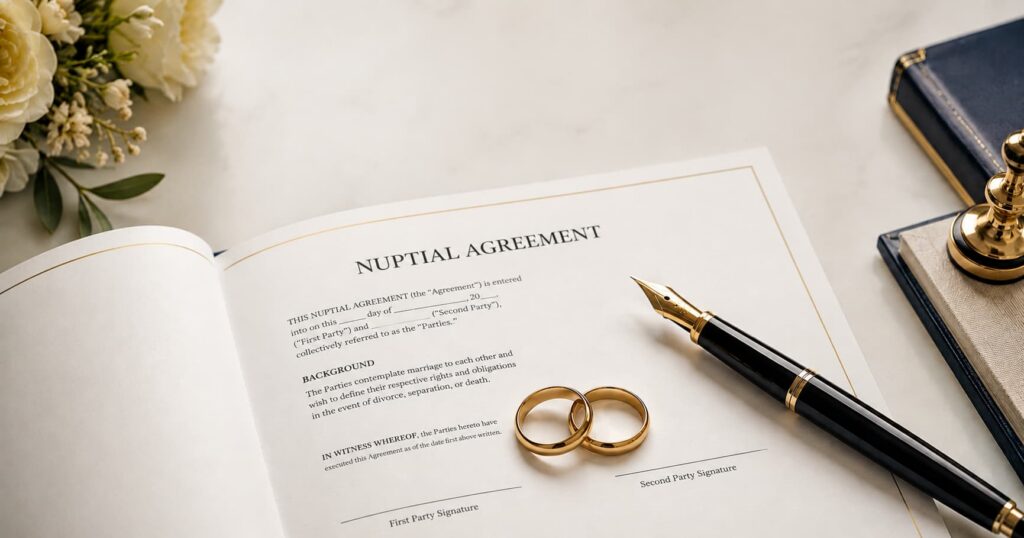
A pre-nuptial agreement (“prenup”) is a document which a couple enters into before they get married or enter into a civil partnership. The prenup sets out how the financial assets and matters will be divided and handled in the event of a divorce. This is usually structured by setting out each party’s “separate property” and determining what the couple agree will happen financially in the event of divorce.
Inherited wealth is often defined as separate property and the pre-nuptial agreement can work to ringfence these assets. Prenups can also help to reduce potential disputes at the time of the breakdown of the marriage as they can set out a clear structure on how the finances shall be handled.
If you wish to protect inherited assets in a prenup, provision can also be made in the pre- nuptial agreement to protect any future income which is generated by that asset so income remains “separate property.” This is something which we have agreed in previous pre-nuptial agreements that we have done.
In England and Wales, the court retains jurisdiction over financial arrangements on divorce and does not have to be strictly bound by prenuptial agreements. That said, the court will likely uphold the nuptial agreement and give it significant weight, if it was entered into freely, fairly and with full financial disclosure between both parties and each party having independent legal advice. Ideally, the pre-nuptial agreement would be signed at least 28 days prior to the wedding. The pre-nuptial agreement must also be fair at the time of divorce. If the prenuptial agreement does not meet the needs of a party, or the children, at the time of divorce, then there is a risk it might not be upheld. Certain factors must be taken into consideration when drafting a nuptial agreement. These factors are discussed further below.
There are many advantages to a prenup including having more clarity and certainty in the event of a divorce. Additionally, it is a way to protect inherited wealth, family businesses or other significant assets which have been passed down through generations.
3. What is a Post-Nuptial Agreement?

A post-nuptial agreement is entered into after the marriage has already taken place. A postnuptial agreement is sometimes entered into as a follow up document to a prenuptial agreement, but also as a standalone document within the marriage, for example if circumstances change. If entered into as a follow up to a prenuptial agreement, it can reflect the exact same terms as the pre-nuptial agreement. If done in this way, it confirms that you are happy with the terms of the prenup once you’ve had the opportunity to reflect further on its implications. As such, entering into a post-nuptial agreement will give the pre-nuptial agreement more weight and the court is more likely to uphold it. This is often done if the prenuptial agreement was signed a short time before the wedding, for example if negotiations took longer than expected.
Conversely, during the marriage, there may be a significant change in the financial circumstances of one party or they may inherit a substantial asset from a family member which they want to protect in the event of a divorce. If this happens, a post-nuptial agreement is a way to protect those inherited assets. Similarly, one party may purchase a high-value asset and wish to protect it in the event of divorce in order to preserve that asset for themselves or for a child of their own. We have drafted post-nuptial agreements before where this was the main intention of the agreement.
4. How are Inherited Assets typically treated upon divorce?
On divorce, courts generally treat inherited assets as non-matrimonial property belonging solely to the individual who received the inheritance, meaning those assets are often excluded from division during a divorce. However, this protection is not always automatic or permanent. If inherited funds are mixed with marital assets — such as being used to purchase joint property, or contributed toward shared expenses — courts may determine that the inheritance has become marital property through a process known as commingling. Running these sorts of arguments can be very dependent on the specific facts which can make them difficult to resolve without a lot of evidence.
In light of these complexities, maintaining clear financial records and establishing formal agreements, such as pre-nuptial or post-nuptial contracts, can play an important role in preserving the separate status of inherited wealth.
Provision can be made in pre or post-nuptial agreements that even if funds are co-mingled, the inherited wealth should still be considered separate property. As such, these assets should still benefit from their separate status. This is something which can be drafted into the nuptial agreement and specifically tailored to meet your intentions.
5. Essential Elements of an Effective Nuptial Agreement
For a pre-nuptial or post-nuptial agreement to stand the best chance of being upheld by the court upon divorce, there are several key elements which must be considered when preparing the nuptial agreement.
These factors were set out in the case of Radmacher v Granatino 2010 UKSC 42 and laid the groundwork for future family courts to consider when deciding if a nuptial agreement should be upheld. These factors are set out as follows:
i. Sufficient disclosure has been exchanged;
ii. Both parties have received independent legal advice;
iii. There has been no undue pressure on either party to enter into the nuptial agreement; and
iv. The agreement is fair in the prevailing circumstances
Financial disclosure is essential as it is a requirement for both parties to clearly understand each other’s assets, liabilities, income and expected inheritances before signing the agreement. The parties must fully understand the implications of the nuptial agreement and the rights that they are giving up by entering into the same.
By the same token, independent legal advice is equally important to ensure that each person fully understands the terms of the nuptial agreement and cannot later claim that they were pressured or misled. Although a party might be under pressure to sign an agreement because of the impending wedding date, the courts have been reluctant to consider this as undue pressure and will not set aside an agreement on this basis alone. This is why timing is important too. As set out above, ideally the agreement needs to be signed no later than 28 days before the wedding. This is to ensure that situations do not occur where one party is suddenly presented with a pre-nuptial agreement on the morning of their wedding and are forced or pressured into signing it at the last minute.
Courts are also more likely to enforce nuptial agreements that are fair and meets needs at the time of divorce, even if the provision is much less than that which would be ordered without a pre-nuptial agreement. In light of this, it is important for the parties to carefully consider the terms of the nuptial agreement when they are drafting it because if it appears hugely unfair to one party, it may not be upheld.
6. Common mistakes to avoid
Considering a nuptial agreement can be emotionally challenging and time-consuming. One of the biggest mistakes couples make when creating a pre-nuptial or post-nuptial agreement is leaving discussions until the last minute. This can lead to claims of undue pressure or unfairness later on in the event of a divorce. To avoid this, ensure you have those initial discussions with your partner early on. Additionally, it is helpful when couples have discussed the terms of the agreement directly between themselves as this can sometimes help to reduce the time spent in negotiations between solicitors.
You might be tempted to prepare the initial agreement yourself but this can cause issues with drafting. Avoid using generic online templates as these ‘self-made’ nuptial agreements often fail to account for individual circumstances or cases with complex assets. It is much better to have a nuptial agreement drafted by legal professionals so that the agreement can be tailored to your individual needs.
Finally, during the disclosure process, attempting to hide, undervalue, or omit assets can seriously undermine the credibility and enforceability of the nuptial agreement. Full transparency throughout the process is essential and will better help to achieve your aims.
7. Emotional and Relationship Considerations

Discussions about pre-nuptial and post-nuptial agreements can often feel uncomfortable, particularly when inherited assets are involved. Approaching the conversation openly and with sensitivity can help reduce tension and misunderstanding. Rather than viewing these agreements as a sign of mistrust or an expectation of divorce, many couples now see them as a practical form of financial planning that promotes clarity and transparency within the relationship.
If you are worried that the agreement will read too much as though divorce is expected or inevitable, it is crucial to communicate your intentions to your partner. The wording of the nuptial agreement can be tailored depending on your intentions and desired outcomes, for example protecting inherited assets.
Honest conversations about money, inheritance and long-term expectations can strengthen communication and having a nuptial agreement recording this can help both parties feel more secure about the future.
8. When to seek Professional Advice
Family lawyers can help ensure that the nuptial agreement complies with current laws and is drafted in a way that is fair, clear and more likely to be upheld by the courts upon divorce or if challenged.
If you are due to get married and want to protect inherited assets now or in the future or if you are already married and want to ringfence those assets in the event of a divorce, obtaining tailored legal advice now will not only strengthen your understanding of what can be done but will also provide you with greater confidence and clarity for both parties moving forward.
9. FAQs
Generally, inheritance is deemed non-matrimonial property. However, the court can depart from this if the inheritance is needed to meet one party’s needs, or the needs of any children. More protection will be afforded if a pre- nuptial or post-nuptial is in place which classes the inherited assets as separate property.
If inherited money is mixed with marital funds, this could lead to complex arguments on divorce that the inheritance has been ‘matrimonialised’, meaning that it should be included in the assets that will be divided between the parties as part of the overall financial settlement.
Yes, a nuptial agreement can protect future inheritances as these types of assets can be included in each party’s ‘separate property’ schedules. These schedules will set out an itemised list of assets that each party wishes to ringfence and confirm that the parties agree those assets are not up for division in the event of a divorce. It doesn’t matter if future inheritance cannot be precisely particularised at the time of drafting the pre-nup or post-nup but an approximate value can be given.
If you are not yet married, then yes! If you are already married, you should consider proposing a post-nuptial agreement.
10. My experience
My name is Alice Carter and I am a Trainee Solicitor at Edwards Family Law. I have worked at the firm for over 3 years, and I have assisted the team in drafting many pre-nuptial and post-nuptial agreements where one of the main aims was to protect inherited wealth. Please do not hesitate to get in touch should you have any questions arising from this article.